Ticket to Dice - Trains Tracks
FunCraft GamesBoard
4.445.00 Reviews
- Version
- 1.0.29
- Installs
- 10.00K
- Age Rating
- Everyone
Screenshots
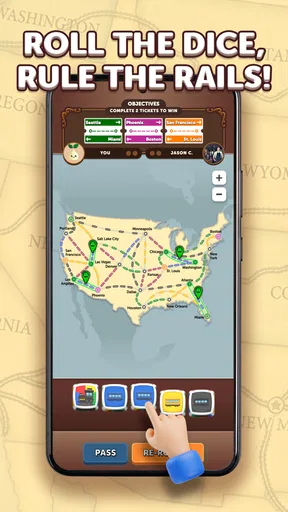
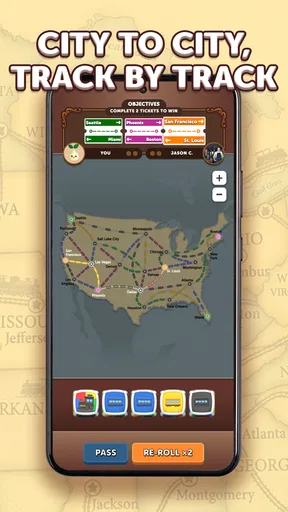
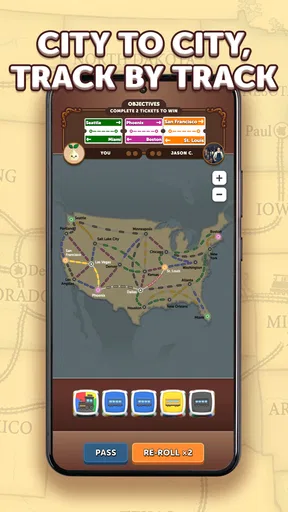
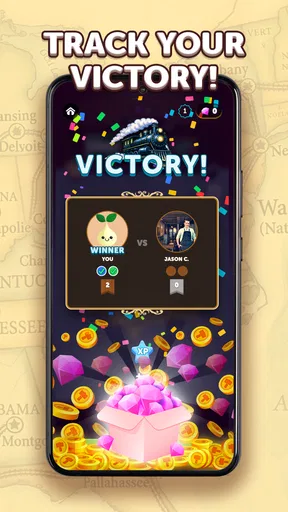
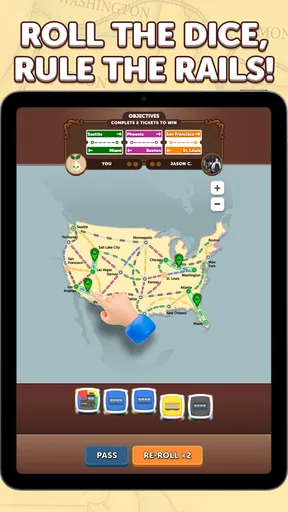
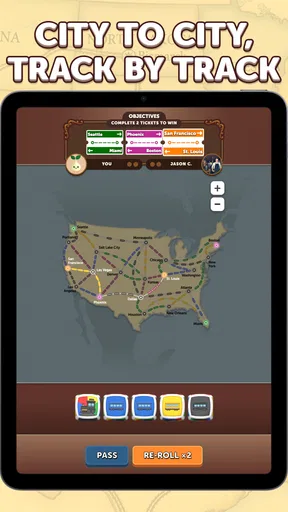


Our Review of Ticket to Dice - Trains Tracks
 Analysis by Appyee
I spent time with Ticket to Dice - Trains Tracks as a casual board game built around dice, route decisions, and competition on a map of the United States. Its basic appeal is easy to understand: each turn asks me to balance luck with planning while trying to secure useful train connections before other players take the opportunities I want. That makes it more interesting than a simple dice roller, but less demanding than a long strategy game that requires constant concentration.
The game comes from FunCraft Games and is free to start, with optional purchases ranging from $0.99 to $49.99 per item. It is rated for Everyone, which makes it suitable for a broad audience in principle, although the practical experience still depends on how comfortable each player is with small on-screen information, turn-based decisions, and the visual presentation of a map. I found it most appealing for short sessions with family or friends who enjoy board-game tension without needing a complicated rulebook.
How clearly the game communicates its board and choices
The strongest part of the concept is the familiar relationship between the map and the routes. I can look at the United States as a playing space, think about which connections matter, and decide whether to pursue a useful line now or wait for a better opportunity. That structure gives every turn a clear purpose. Even when the dice introduce uncertainty, I am rarely left wondering why a decision matters.
For a new player, the central loop is approachable because the actions are recognizable. Roll, evaluate the available route possibilities, and choose how aggressively to compete. The challenge is not learning a huge collection of unrelated systems; it is understanding how a small decision can affect later access to the map. I would still recommend playing the opening turns slowly, especially when introducing the game to someone who does not normally play digital board games.
Readability matters more here than it might in a card game with a mostly static screen. The board can contain several competing routes, and the player needs to distinguish their own progress from the routes claimed by rivals. I found that the game works best when I pause before tapping, rather than treating each turn as a reflex exercise. That habit also helps players who need extra time to process visual information or compare several choices.
Navigation is helped by the focused design. This is not an app that asks me to move through a large social hub, manage a long inventory, or remember many unrelated menus. The board remains the center of attention. That simplicity is valuable for players who become overwhelmed by busy interfaces, although a crowded map can still make route selection less comfortable once several actions and claimed paths compete for attention.
A useful approach is to separate “what can I do?” from “what should I do?” First, I identify the legal or available move. Then I consider whether it improves my position or merely reacts to another player. That two-step pause makes the game easier to follow and reduces accidental choices. It is also a good way for a parent, group leader, or experienced player to explain the game without taking over someone else’s turn.
Learning the map without rushing
The American map gives the game a sense of place, but geography can also create a learning curve. Players who already recognize major locations may form a mental picture quickly, while others may need more time to understand how one route relates to another. I do not see that as a flaw in the theme, but it does mean that the game is not equally immediate for everyone.
When I play with someone new, I find it better to explain the strategic idea rather than list every possible route. I point out that a short connection can be valuable if it blocks a rival or opens a later path, while a longer-looking route may be less useful if it leaves too few alternatives. This turns the first session into a guided discovery instead of a test of memory.
The best accessibility choice a player can make is to keep the first session low-pressure. Avoiding a race to explain every tactic gives people time to recognize colors, map positions, and turn results at their own speed. Because the game is free to begin, it is practical to try this relaxed approach before spending anything on optional items.
Motor and sensory considerations during play
From a motor perspective, the game is more forgiving than an action title. The important decisions happen in turns, so I am not required to aim quickly, hold a button during a timed sequence, or react to an enemy in real time. That makes it a reasonable choice for players who prefer deliberate tapping and who find fast games tiring.
Turn-based pacing also helps when playing in a shared environment. Someone can set the device down, discuss a choice, or take a short break without missing a rapidly changing battle. In my experience, that makes the game easier to include in a family setting where players may be interrupted by conversation or everyday tasks.
There is still a difference between slow gameplay and effortless controls. Selecting a route on a map can require visual precision, particularly when nearby paths or markers are close together. I recommend using the largest comfortable display available and holding the device steadily rather than playing while walking or riding in a moving vehicle. Those simple changes make route selection less frustrating.
Sensory comfort is more complicated because a board game can still be visually busy even when it is not fast. Dice results, route colors, rival progress, and map details may all compete for attention. Players who are sensitive to animation, contrast, or changing visual elements should try a short session first and see whether the presentation feels comfortable. I would not assume that an Everyone rating automatically means every visual style will suit every person.
Color recognition is another practical consideration. Route-based games often depend on distinguishing visual categories quickly, and that can be harder for players with color-vision differences or anyone using a dim screen. I found it safer to confirm choices through the shape, position, or surrounding context of a route rather than relying on color alone. If a player has trouble separating the map elements, playing collaboratively can help: one person can describe the route while the other makes the decision.
Playing with different energy levels
The game is a good fit for low-energy moments because it does not demand constant physical input. I can make a move, watch the situation develop, and think about the next turn. That said, the mental workload can rise when several rivals compete for the same area. Someone who wants a completely passive experience may prefer a simpler dice game, while someone who enjoys quiet planning will probably appreciate the tension.
Sound can influence comfort as much as visuals, but I judge the game primarily by its board decisions rather than by any audio element. If I am playing in a quiet room, a low device volume or headphones can make the session easier to control. In a group, keeping the sound unobtrusive helps the game remain part of the conversation instead of taking over the room.
One non-obvious strength is that the turn structure creates natural opportunities for shared decision-making without requiring one player to control the entire match. A friend can ask, “Which route would you consider?” and the player can still make the final choice. This works well for children learning planning skills, older relatives who prefer a slower pace, or anyone who benefits from verbalizing options before acting.
Situational access in everyday play
I can imagine using this game during a short break, on a sofa with family, or as a light activity when a group wants something more engaging than a basic roll-and-move board game. The United States map gives conversations a useful anchor: players may discuss regions, routes, and rival plans while waiting for the next turn. That social layer is more important than the raw mechanics for people who treat games as a way to spend time together.
It also suits players who do not want to commit to a long rules-heavy session. The core idea can be explained in ordinary language, and the competition comes from deciding where to invest attention. I would choose it for a mixed group in which one person enjoys strategy but another dislikes complicated tabletop systems. The dice keep outcomes from becoming completely predictable, while the route choices give experienced players something to think about.
For a commute or a waiting room, the suitability depends on how stable the player’s attention can be. A turn-based game is easier to pause mentally than a real-time game, but a crowded public place can make map reading and precise tapping more difficult. I would play it when seated with enough time to finish a few decisions, not when I expect constant interruptions.
Screen size changes the experience. On a larger phone or tablet, the map is easier to inspect and route relationships are more comfortable to compare. On a smaller screen, I would expect to zoom in mentally by concentrating on one region at a time, which can slow the game down. That is not a reason to avoid it, but it is a meaningful trade-off for players who rely on large text or clear separation between controls.
Because the game is free, trying it with a group is low-risk. However, the presence of optional purchases means I would set expectations before handing the device to a child. The game is suitable for Everyone by age rating, but purchase decisions are still a separate household matter. I would use the same practical rule as with any free-to-start game: enjoy the basic play first and treat paid items as optional rather than necessary for deciding whether the design is fun.
Who benefits most from the format
I think it works best for three kinds of players. First, casual board-game fans who want a digital version of route competition without setting up a table. Second, families looking for a game that can be discussed together instead of played through frantic reactions. Third, strategy beginners who want to practice weighing immediate rewards against future possibilities.
It is less suitable for someone seeking a deep simulation with extensive customization, a large campaign, or highly precise control over every outcome. The dice are central to the rhythm, so a player who dislikes luck influencing strategy may become annoyed even when their decisions are sensible. In that case, a more deterministic board game would be a better choice.
It is also not my first recommendation for players who need exceptionally large interface elements, strong non-visual alternatives, or a completely uncluttered presentation. I can make the experience more manageable through slower play, a larger screen, and verbal support, but those are workarounds rather than proof that every player will find the interface equally comfortable.
Remaining barriers and practical trade-offs
The main barrier is the map itself. A route board is attractive because it creates a sense of territory and competition, but it also places a lot of information in one visual space. Players may need to inspect small areas, compare nearby lines, and remember which options remain useful. That can be tiring for anyone with visual-processing difficulties, especially during a close match.
Another barrier is the combination of chance and competition. A player may understand the best move and still receive an unfavorable dice result or lose access to a route because a rival acts first. That uncertainty is part of the appeal, but it can be discouraging for people who prefer clear cause and effect. I found that treating each turn as a new puzzle reduces the frustration; trying to force one perfect plan does the opposite.
The game can also expose differences in experience between players. Someone familiar with route-building tactics may identify blocking moves quickly, while a newcomer is still learning the map. To keep the match inclusive, I would avoid giving unsolicited instructions every turn. Instead, offer one explanation at the start, allow extra thinking time, and let the newer player experiment. This preserves their ownership of the game.
Optional purchases deserve a measured approach. The free entry point is helpful, but the price range means the game can become a more serious spending decision if a player starts browsing several items. I would not recommend buying anything until the basic loop has proved enjoyable across multiple sessions. For families, agreeing on a spending limit beforehand is a simple way to keep the focus on the board rather than on purchases.
The current version is 1.0.29 and requires Android 7.0 or later. That makes checking the device’s operating-system compatibility a sensible first step before planning a group session. A player who cannot install the game on an older phone may need to use another device or choose a traditional board game instead. This is a practical issue, particularly in households where one shared phone is used by several people.
The audience response is encouraging without being so large that I would treat it as universal proof of quality: the game holds a 4.4 average from around 188 ratings, with about 45 written reviews and over 10K installs. I read that as a sign of early interest rather than a guarantee that every accessibility need or play style is covered. My own impression is similarly balanced: the concept is inviting, but the map and luck-based competition decide whether it will suit a particular player.
My inclusive verdict after playing
I came away liking Ticket to Dice - Trains Tracks most as a social, turn-based board game that gives players time to think. Its route-focused design is easier to approach than a dense strategy title, and the lack of real-time pressure makes it more welcoming for people who prefer slower interaction. The United States map gives decisions a concrete shape, while the dice keep the contest from becoming a simple exercise in memorizing the best moves.
Its accessibility is strongest in pace and mental flexibility. Players can discuss options, pause between turns, and learn through repeated choices rather than needing fast reactions. It is weaker where map-heavy interfaces are concerned: visual crowding, route distinction, and precise tapping may still create friction. I would introduce it with a larger screen, a relaxed first match, and permission for every player to take the time they need.
My most useful tip is to play by regions rather than trying to understand the entire country at once. Identify the area that affects your immediate route, check how a rival might use it, and then decide whether the safer move is more valuable than the ambitious one. That approach reduces visual overload and also improves strategy because it keeps attention on consequences instead of on every possible connection.
I would recommend it to friends who enjoy accessible board-game ideas, shared planning, and a little unpredictability. I would steer players elsewhere if they need very large controls, non-visual interaction, a purely skill-based system, or a game with no purchase temptation. For everyone else, the free starting point makes it easy to test the fit. The best reason to try it is not the dice alone, but the way each roll turns the map into a small decision-making problem.
FunCraft Games has chosen a familiar theme and given it a compact digital form. The result is not perfect for every ability or setting, but it has a clear identity: a friendly route contest that can be played thoughtfully, explained conversationally, and adapted through patience and cooperation. If that sounds like the kind of board game you would enjoy sharing, I think it is worth giving a few unhurried sessions before deciding whether its visual demands and luck-driven turns work for you.
Verdict
Strengths of Ticket to Dice - Trains Tracks
- Simple rules make it easy for new players to start quickly.
- Short matches fit well into quick gaming sessions.
- Route-building choices add satisfying tactical depth.
- Works well for casual play with friends or family.
- Train-themed visuals give the game a pleasant atmosphere.
Limitations of Ticket to Dice - Trains Tracks
- Limited strategic variety may reduce long-term replay value.
- Some matches can feel repetitive after extended play.
- Luck may strongly influence the outcome of close games.
- The interface can feel small on phones with compact screens.
- Online features may depend on an active player community.
Other Releases by FunCraft Games
View All


Similar Picks in This Category
View All
Ludo King®
Gametion4.1

Ludo
Yarsa Games4.6

Tile Master® - Matching Game
Higgs Studio3.6

Checkers Online
CC Games4.6

Dominoes
Loop Games4.7

Chess
Chess Prince4.6
Frequently Asked Questions
What is Ticket to Dice - Trains Tracks?
Ticket to Dice - Trains Tracks is a strategy board game inspired by classic route-building games. Players roll dice, collect the required colors or symbols, and use them to claim railway connections between cities. The main objective is to complete routes, earn points, and plan more efficiently than your opponents while managing the uncertainty created by the dice.
How do you play Ticket to Dice - Trains Tracks?
Each turn generally involves rolling dice and deciding how to use the results to build train tracks or work toward destination objectives. Successful play requires balancing short-term opportunities with longer routes that may provide more points. Before downloading, remember that the game combines luck and strategy, so even a well-planned move can be affected by an unfavorable roll.
Can Ticket to Dice - Trains Tracks be played offline?
The availability of offline play may depend on the specific version and game mode offered on your device. Some board-game apps allow solo play against computer-controlled opponents without a constant internet connection, while online features usually require access to the network. Check the store description and permissions before installing if offline gaming is important to you.
Is Ticket to Dice - Trains Tracks suitable for beginners and children?
The basic concept is relatively easy to understand because the game focuses on rolling dice, collecting useful results, and connecting destinations. However, completing routes and choosing when to take risks can require strategic thinking. It may suit families and casual players, but younger children could need help understanding scoring, objectives, and the consequences of competing for limited connections.
Does Ticket to Dice - Trains Tracks include purchases, advertisements, or multiplayer features?
The exact monetization and multiplayer options can vary according to the Android or iOS release, region, and version installed. Before downloading, review the official store listing for information about advertisements, in-app purchases, account requirements, and online play. If you prefer a completely uninterrupted board-game experience, these details are especially important to verify beforehand.
Play our best games!


